


Authorship: Yasmin Saba de Almeida
Collaboration: Prof. Elaine Antunes Cortez, Ph.D. – Federal Fluminense University
“I heard that Qualis is going to end... is that true?”
This is probably the question most often heard in graduate school hallways. The answer is no, Qualis will not end, but it will undergo profound changes.
Starting with the 2025-2028 evaluation cycle, CAPES will implement a new model for evaluating the scientific output of graduate programs (PPGs), in which the focus will shift from journals to individual articles.
The End of Traditional Qualis Journals
What is Qualis, anyway?
Qualis is a scientific journal classification system used by the Coordination for the Improvement of Higher Education Personnel (CAPES) to evaluate the quality of scientific production in Brazilian PPGs. Contrary to what many people think, it is not a certification of the journal, nor is it a permanent "seal of quality" for the journal.
Qualis classifies the journals in which PPG faculty and students have published during an evaluation cycle and then uses this classification as part of the program's performance analysis. This means that the score assigned is only valid for that specific period. Therefore, when we look at the 2017-2020 evaluation, the stratum corresponds exclusively to that time interval, and the journal can either improve or worsen over the years.
Not every journal has Qualis, since the system does not evaluate “all journals”, but rather the production of graduate programs based on the journals in which their faculty and students have published. A journal only appears in Qualis because a program has published in it; if no PPG has published articles there during the four years, it is simply not classified. This means that Qualis reflects what was actually produced during the period, rather than a general catalog of existing journals.
For example, imagine an excellent international cardiology journal, but no Brazilian researcher affiliated with a PPG has published in it in the last four years. That journal will simply not appear on the Qualis list for those four years, regardless of its quality or impact.
How has it worked until now?
Currently, Qualis organizes journals into nine strata, ranging from A1 (the highest) to C (no score). The logic is simple: the higher the stratum, the greater the impact and scientific visibility of the journal in the four years evaluated.
A1 → A2 → A3 → A4 → B1 → B2 → B3 → B4 → C
The A strata (A1, A2, A3, A4) represent the "elite" of journals. A1 brings together journals with the greatest global impact, with a consolidated presence in databases such as Scopus and Web of Science. As we move on to A2, A3, and A4, the impact decreases slightly, but we are still talking, in theory, about journals with good international visibility, rigorous editorial review, and solid editorial standards.
The B strata (B1, B2, B3, and B4) include journals with more moderate impact, but which still play an important role, especially for Brazilian science. It is common to find many well-established national journals here, including journals indexed in SciELO or DOAJ, which are highly relevant within their fields. B1 and B2 usually represent journals of national excellence, while B3 and B4 include serious journals, but with more limited reach or lower metrics.
The C strata is the level that requires the most attention. It assigns zero weight to the journal in the evaluation. A journal can be classified as C for several reasons: very low impact, absence of relevant indexes, editorial weaknesses, or even consistent quality problems. This is where predatoryjournals may appear, but also new journals that are still developing or have not yet met the minimum criteria to be classified in higher strata.
It should also be noted that the 2017–2020 and 2021–2024 cycles have adopted the so-called Qualis Reference for defining strata. In this model, the parent area is responsible for assigning the journal's general stratum. In practical terms, each journal now has a single official classification, defined by the area in which it publishes most. Therefore, there are no longer different Qualis classifications for the same journal; if it is B1 in the parent area, it will be B1 in all areas.
Why is Qualis changing?
The traditional Qualis model, despite having been useful for years, had significant limitations. The main criticism was that it only evaluated the prestige of the journal, without considering the individual quality of each article, so that a “weak” article published in an A1 journal was worth more than an excellent article published in a B3 journal.
The system indirectly devalued the thematic adherence of the research to the journal's scope by encouraging a “race for strata”. In addition, it ended up penalizing national journals that had not yet achieved international indexing, even when they published research that was fundamental to the Brazilian context.
Did you know that it is no longer the journal that will be classified, but rather the article individually?
According to the Report of the Working Group created by CAPES (2024b), the evaluation areas will be able to choose between three different procedures to classify bibliographic production in the 2025-2028 cycle.
The Nursing area will adopt Procedures 2 and 3, prioritizing the impact of the article over the prestige of the journal.
Procedure 1 – Focus on the JOURNAL
Procedure 1 maintains the logic of classification based on the prestige of the journal, using internationally consolidated bibliometric indicators: CiteScore (Scopus), Journal Impact Factor/JIF (Web of Science), and h-index (OpenAlex/Google Scholar). The main change is that the former strata B1-B4 now correspond to the new A5-A8. Stratum C remains with zero weight in the evaluation.
A1 → A2 → A3 → A4 → A5 → A6 → A7 → A8 → C
The CiteScore, provided by the Scopus database (Elsevier), calculates the average number of citations received by articles in a journal over the last four years. It adds up all citations received during this period and divides them by the total number of documents published. The higher this average, the greater the influence of the journal tends to be.
The Journal Impact Factor (JIF), calculated by Web of Science (Clarivate Analytics), measures the average number of citations that articles in a journal have received in the previous two years. For example, if a journal published 100 articles in 2022 and 2023, and those articles received 400 citations in 2024, the JIF would be: 400 ÷ 100 = 4. It is essential to note that only Clarivate's official JIF is considered valid in the Qualis evaluation. Journals that claim to have an "impact factor" but are not listed in the Web of Science database should be viewed with caution, as they may be using metrics that are not recognized by the scientific community.
The Índice h, estimated by Google Scholar Metrics and OpenAlex, measures how many articles in a journal have received at least the same number of citations. For example, if a journal has an h-index = 20, this means that it has published 20 articles that have each received at least 20 citations. Even if some articles have 100 or 200 citations, the index does not increase beyond this level because it only considers the group of articles that consistently achieve impact. Both Google Scholar and OpenAlex calculate this indicator using the same mathematical principle, but differ in the database used and the time window considered. Each platform accesses different sources and has its own criteria for counting publications and citations, which can result in different h-index values for the same journal. Google Scholar provides h5 (last 5 years) and h10 (last 10 years), while OpenAlex calculates the overall h-index, considering the entire publication history of the journal since its creation.
It is important to note that the procedure for converting these indicators into percentiles depends on the type of metric used. When the field adopts CiteScore and JIF as the main metrics, the percentiles already provided by the Scopus and Web of Science databases are used. On the other hand, when the field opts exclusively for the use of the h-index, CAPES calculates the percentile directly, based on the distribution of this indicator among journals in the field.
Example: Consider that the journal “Journal of Future Nursing” is indexed only in Google Scholar Metrics, with h5 = 28. Since there is no ready percentile for the h-index, CAPES compares this value with the h-index of all journals in the field. If this performance places the journal above 70% of the journals evaluated, it will be classified in the 70th percentile, ranking as A3.
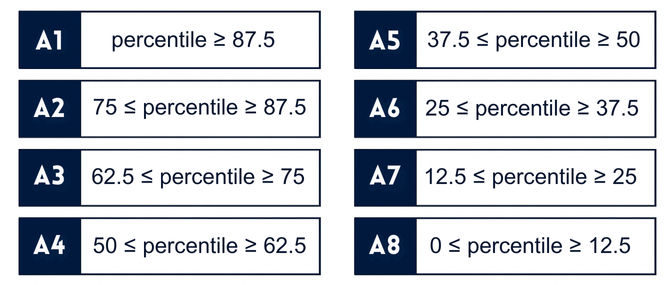
After defining the final percentile, CAPES organizes the journals into strata of equal amplitude, distributed in 12.5% ranges, as follows (Figure 1):
Figure 1. Stratification of journals by percentiles in the new Qualis
Source: Adapted from Brazil (2025c, p. 42).
Thus, when a journal is in the 90th percentile, this means that it performs better than 90% of the journals evaluated in that same thematic category and is therefore classified in stratum A1.
If the journal is indexed in more than one database—for example, simultaneously in Scopus and Web of Science—CAPES considers the highest percentile obtained, that is, it uses the journal's best performance to define its final stratum.
Procedure 2 – Focus on individual ARTICLES
Procedure 2 takes as a reference the stratum assigned in Procedure 1 and proceeds to classify articles based on the journal's qualitative criteria and individual citation bibliometric indicators. In practice, suppose that an article has been published in the “Journal of Future Nursing", classified as A3 in Procedure 1. In this case, the article begins its evaluation in stratum A3 and may or may not move up in stratum according to the two additional criteria considered below.
The evaluation begins with a qualitative analysis of the JOURNAL in which the article was published. At this point, criteria such as editing and indexing, open access, and the value of national journals, among others, are considered. In this regard, CAPES has established a guideline common to all areas for improving the quality of articles, which is the indexing of the journal in SciELO. Thus, if the journal meets these criteria, the classification by qualitative criteria may change the initial stratification (A1 to A8) received in Procedure 1.
Subsequently, each ARTICLE is evaluated based on its own bibliometric performance, considering the citation index (how many times the article has been cited by other works), altimetry (repercussion on social media and digital platforms), among others. The Nursing area, for example, established that articles that are among the top 5% most cited within each journal can rise a maximum of one level from their original classification. Thus, an article initially classified as A3 can be reclassified as A2 if it has a high citation index.
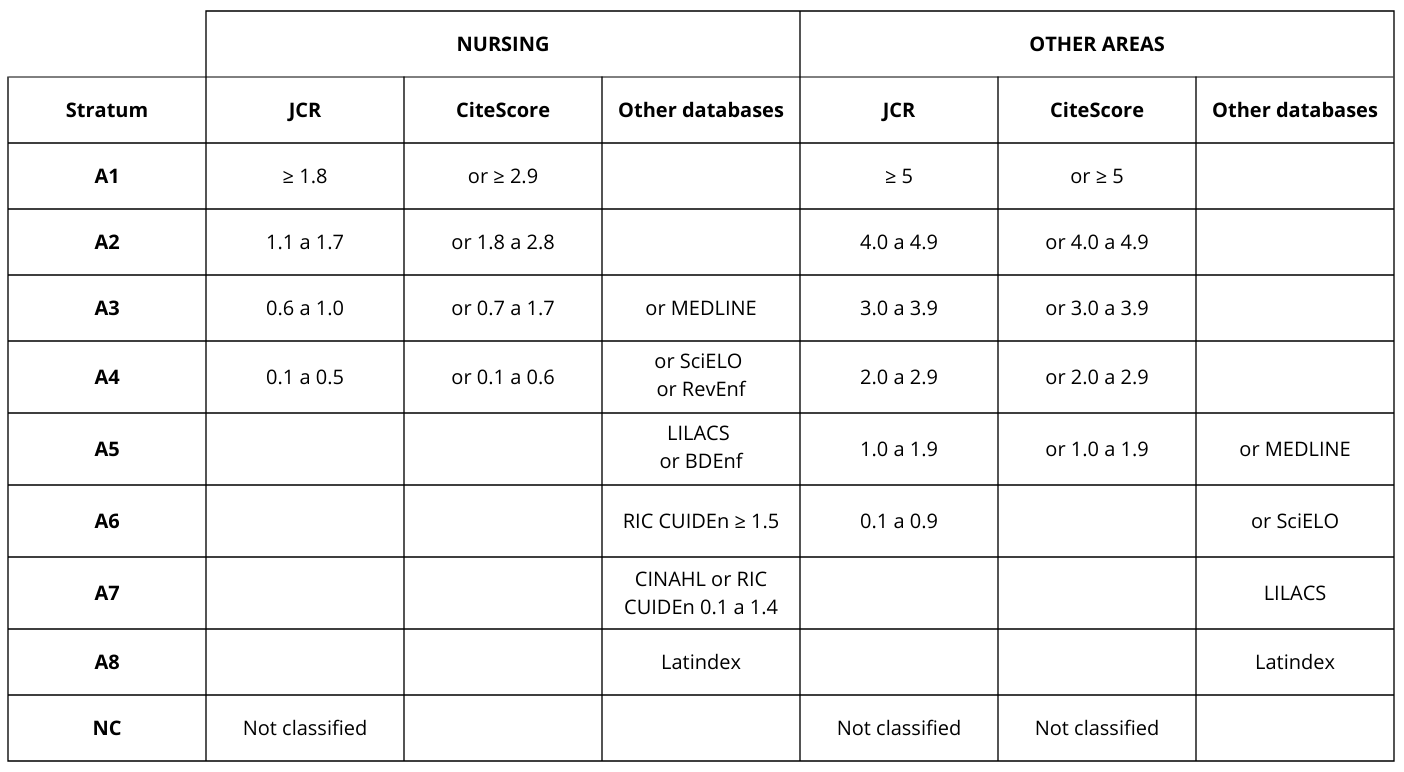
To carry out Procedure 2, the Nursing area defined specific indicators for the initial classification of articles published in journals in the area, to value the characteristics of the field without devaluing national production. These indicators can be seen in Figure 2:
Figure 2. Criteria established by CAPES for classifying articles published in Nursing journals
Source: Adapted from Brazil (2025d, p. 28).
This means that, for journals whose parent field is Nursing:
- Stratum A1: Journals indexed in Web of Science with JIF equal to or greater than 1.8 OR journals indexed in Scopus with CiteScore equal to or greater than 2.9.
- Stratum A2: Journals indexed in Web of Science with JIF between 1.1 and 1.7 OR journals indexed in Scopus with CiteScore between 1.8 and 2.8.
- Stratum A3: Journals indexed in Web of Science with JIF between 0.6 and 1.0 OR journals indexed in Scopus with CiteScore between 0.7 and 1.7 OR journals indexed in MEDLINE. That is, journals indexed in MEDLINE are automatically classified in this stratum, even without presenting JIF or CiteScore.
- Stratum A4: Journals indexed in Web of Science with JIF between 0.1 and 0.5 OR journals indexed in Scopus with CiteScore between 0.1 and 0.6 OR journals indexed in SciELO OR journals indexed in RevEnf. Thus, journals indexed in SciELO or RevEnf automatically enter this stratum, even without JIF or CiteScore.
- Stratum A5: Journals indexed in LILACS OR journals indexed in BDEnf.
- Stratum A6: Journals indexed in RIC CUIDEn with an index equal to or greater than 1.5.
- Stratum A7: Journals indexed in CINAHL OR journals indexed in RIC CUIDEn with an index between 0.1 and 1.4.
- Stratum A8: Journals indexed in Latindex.
- NC (Not Classified): Articles published in journals not present in any of the databases mentioned above or associated with dubious editorial practices are classified as unclassified. These articles have zero weight in the evaluation and do not contribute to the PPG.
NOTE: Among strata A1 and A4, when a journal is present in more than one database, the classification corresponding to the highest metric presented will be adopted.
Procedure 3 – Qualitative Analysis of the ARTICLE
Procedure 3 is the stage at which the evaluation ceases to rely solely on quantitative indicators and begins to examine, more carefully, the quality of intellectual production. While Procedures 1 and 2 perform a more automated classification, here the objective is to understand the scientific contribution of the best PPG productions to the advancement of the research area.
Thus, each PPG selects five works considered most relevant and presents a justification for why they stand out. The preference is for articles, but up to two of them may be replaced by booksif they represent particularly relevant contributions. This choice allows the program to highlight what it considers its best products.
At the end of Procedure 3, the productions receive an overall assessment on a five-point scale: Very Good, Good, Fair, Poor, or Insufficient.
In this regard, the Nursing area intends to conduct a multidimensional assessment to check quality, observing whether: the works are derived from macro-projects, dissertations, or theses; the thematic alignment with the Sustainable Development Goals (SDGs) or with health research priorities; and the conceptual or methodological advancement brought about by the study—whether by innovating, deepening theories, or offering solutions applicable to nursing. Bibliometric indicators, such as citations and digital impact, complement this assessment.
When the program chooses to include books, they will undergo a specific analysis. First, the book's adherence to the field of nursing and the program's profile will be verified; non-compliant works will be automatically discarded. The books that continue in the evaluation will be examined in three dimensions: formal characteristics (type of publisher, language, existence of an editorial board), indirect quality assessment (nature of the work and origin), and direct assessment (innovation, impact, relevance, and student participation). After this stage, they will receive a score from zero to 100 points. Books that score between 85 and 100 points will be classified as L1 (highest quality books), while those between 70 and 84 points will receive an L2 classification (quality books). Unclassified Books (LNC) will be assigned to items that may be included by programs that do not meet the minimum requirements to be considered books, such as primers, teaching materials, or other types of production.
The Technical-Technological Products (PTTs) may also be included in the set of highlighted productions, representing practical applications of the knowledge generated. The evaluation first considers the product's adherence, faculty participation, and the possibility of auditing; items that do not meet these criteria are excluded. Approved products are then evaluated in terms of applicability (scope, replicability, and type of impact), innovation (degree of originality), and complexity (level of elaboration). PTTs that score between 8.0 and 10.0 are classified as T1; those with scores between 6.5 and 8.0 are classified as T2.
What changes for Nursing Researchers?
Impact on Graduate Students
The transition to an article-centered model represents a paradigm shift that can be, paradoxically, both liberating and more demanding for graduate students. On the one hand, it breaks with the perverse logic that a mediocre work in a prestigious journal is worth more than an exceptional contribution in a national journal. On the other hand, it imposes an additional responsibility on the researcher in training, since it is not enough to publish; the work needs to have an impact.
This change can cause anxiety. Students now have to think not only about completing their research and publishing it, but also about disseminating it, engaging the scientific community, and ensuring that their work circulates. In this scenario, there is a risk that students with less academic social capital, lower purchasing power, or belonging to historically marginalized groups—often without established networks of collaboration or well-connected advisors—will see their work undervalued, not because of a lack of quality, but because of a lack of visibility. I even wonder if we are being led to become a kind of “digital influencer” so that our work will be recognized.
At the same time, the valorization of Latin American indexers may represent a rescue of the thematic relevance of studies. Much research that is deeply relevant to understanding the national scenario faced barriers to inclusion, not because of methodological flaws, but because it did not arouse editorial interest in these spaces. In this sense, the new system reinforces that science gains density when it is guided by its own priorities and contributes concretely to the local reality.
Impact on Faculty
For faculty, the new system requires a strategic reorientation that goes beyond the productivist logic of “publishing a lot”. The question becomes: what to publish, where, why, and with what impact? This demands intellectual maturity and the ability to evaluate one's own production not only by quantitative metrics, but by effective contributions to the field.
Furthermore, there is a generational challenge in this transition. Faculty trained under the aegis of the traditional Qualis built their careers pursuing high strata, often sacrificing thematic relevance in favor of journal prestige. Now, they need to reprogram their academic compasses and, more importantly, guide a new generation of researchers under criteria different from those that guided them.
The new system shifts a significant part of the evaluation from the individual to the collective level. The logic is no longer just the sum of each professor's output, but rather the construction of a narrative about what the program has actually accomplished. The selection of the five most relevant outputs is no longer an administrative task but becomes an exercise in joint self-assessment. This shift may generate internal tensions—after all, what type of research should prevail? Applied or theoretical? International or national?—but it also has the potential to strengthen the intellectual identity of faculty members and the program itself.
What does this change in practice?
In practice, this new model profoundly changes the rules of the game for researchers and programs. It has obvious advantages, but it also exposes weaknesses that were previously hidden behind high strata. The positive point is that those who produce with depth, consistency, and purpose tend to gain ground. A solid, well-constructed article capable of generating real impact is now worth more than three fragile texts published just to “fill the quota”. Researchers who work rigorously, build coherent trajectories, and are concerned with the circulation of their ideas are likely to benefit the most.
On the other hand, the change puts pressure on practices that have become common in graduate studies, such as publishing in a hurry, excessively fragmenting results, choosing journals just because “it always worked”, or seeking the highest stratum without considering whether the journal really engages with the researched topic. Now, publishing a lot and having little impact is no longer a viable strategy. An article that is not cited, does not circulate, and does not engage with its field will carry little weight, even when published in a recognized journal.
For programs, the message is equally clear: a large volume of publications disconnected from the lines of research is no longer an advantage. What CAPES now values is consistency, that is, a set of productions that indicate where the program is heading, what it is investigating, and how this contributes to the development of the field. Disorganized programs that accumulate articles without a strategy or allow for loose and poorly guided student productions tend to lose strength. Those who properly structure their lines of research, encourage collaboration, ensure methodological quality, and invest in broader research should stand out.
In this context, it is also essential to rethink some internal practices, especially those that require students to publish several articles in addition to their dissertation or thesis. This type of requirement, when disconnected from the maturity of the study or the time available, often results in rushed publications that are poorly aligned with the program's lines of research and have limited impact. It is not a matter of eliminating the requirement for production, but of seeking balance. Encouraging solid, well-guided, and carefully constructed research tends to generate more relevant results than imposing quantity goals—something that the new model no longer values in the same way.
So now, what do I, as a researcher, need to do?
- Follow CAPES' official updates: To fully understand the new system, access the Common Evaluation Guidelines and the Nursing Area Document. Also, follow the Sucupira Platform, where CAPES publishes all updates, clarifications, and news about the 2025-2028 cycle.
- Choose the journal strategically: Do not limit yourself to the stratum; pay particular attention to the journal's indexing. Journals present in databases such as SciELO, Scopus, MEDLINE, or Web of Science already guarantee minimum classification levels. Also, evaluate thematic adherence, as the article needs to be in line with the journal's scope to have a real chance of making an impact.
- Invest in the quality and methodological rigor of the manuscript: Individual evaluation will depend, to a large extent, on future citations. This implies clear writing, a well-defined contribution, consistent dialogue with the literature, and, above all, methodological rigor. Weak or poorly reported methods are unlikely to gain enough credibility to generate citations. It is not enough to publish; the work must be methodologically sound to be truly citable.
- Publicize your research: Citations do not arise spontaneously. Present your results at events, share them in academic networks, and establish contact with other researchers in the field. Bibliometric impact depends on both the quality and visibility of the work.
- Track the performance of the article: Monitor citations in databases such as Google Scholar, Scopus, or Web of Science. Articles that stand out may rise in rank, but this requires continuous monitoring so that you know when yours is gaining traction.
How to check journal indexing?
1. Scopus
Official link: https://www.scopus.com/sources
How to use:
- Access the official link.
- Search for the journal name or ISSN.
- If the journal is on the list, it is indexed in Scopus.
- Click on the journal title to open the full page.
- Check CiteScore, percentile, categories, SJR, SNIP, and coverage.
To access the full documents (articles), detailed metrics for each publication, and advanced analysis tools, you must log in with your institutional credentials. This also allows you to compare up to 10 journals simultaneously and download the complete list of Scopus sources in Excel (option in the upper right corner). In this case, you must create a Scopus account while logged in with your institutional credentials.
Institutional access (via CAPES Portal):
- Go to: https://www.periodicos.capes.gov.br
- Click on “Acesso CAFe” [CAFe Access] (Federated Academic Community).
- Choose your institution (e.g., UFF, USP, UFRN, UNIFESP).
- Log in with your institutional credentials.
- You will be redirected to the authenticated CAPES Portal.
- Within the authenticated CAPES Portal, search for “Scopus”.
- Click on "Ver no editor" [View in editor] to access the platform.
- In Scopus, click on "Sources" in the upper right corner.
- Once inside Scopus Sources, search for the journal by subject area, title, publisher, or ISSN.
- Click on the journal title and consult the metrics.
2. Web of Science / Journal Citation Reports (JCR)
Official link (requires institutional access): https://jcr.clarivate.com
How to access institutional access (via CAPES Portal):
- Go to: https://www.periodicos.capes.gov.br
- Click on “Acesso CAFe” [CAFe Access] (Federated Academic Community).
- Choose your institution (e.g., UFF, USP, UFRN, UNIFESP).
- Faça login com seu e-mail institucional.
- You will be redirected to the authenticated CAPES Portal.
- Within the authenticated CAPES Portal, search for “Journal Citation Reports”.
- Click on "Ver no editor" [View in editor] to access the platform.
- In JCR, search for the journal by title, ISSN, category, publisher, or country.
- If the journal is on the list, it is indexed in Web of Science.
- Click on the journal title and consult the metrics.
3. BDEnf (Nursing Database)
How to use:
- Access the official link.
- Search for the journal title in the list (Windows: Ctrl + F; Mac: Command + F).
- If the journal is on the list, it is indexed in BDEnf.
NOTE: There is a chance that this list may be out of date. However, it is still the official source of information for journals indexed in BDEnf.
4. CINAHL (Cumulative Index to Nursing and Allied Health Literature)
Official link: https://about.ebsco.com/m/ee/Marketing/titleLists/cul-subject.htm
How to use:
- Access the official link.
- Search for the journal title in the list (Windows: Ctrl + F; Mac: Command + F).
- If the journal is on the list, it is indexed in CINAHL.
5. Latindex
Official link: https://www.latindex.org/latindex/inicio
How to use:
- Access the official link.
- Search for the journal title or ISSN in the "Directory" category.
- If the journal is on the list, it is indexed in Latindex.
- Click on the journal title and view its complete information.
6. LILACS (Latin American and Caribbean Health Sciences Literature)
Official link: https://lilacs.bvsalud.org/periodicos-indexados-na-lilacs
How to use:
- Access the official link.
- Search for the journal title.
- If the journal is on the list, it is indexed in LILACS.
- Click on the journal title and you will be directed to the journal's official website.
7. MEDLINE (Medical Literature Analysis and Retrieval System Online)
Official link: www.nlm.nih.gov/medline/medline_new_titles.html
How to use:
- Access the official link.
- In the search bar, next to "currentlyindexed[All]," search for the title or ISSN of the journal (note: do not delete "currentlyindexed[All]," type next to it).
- If the journal appears in the results, it is indexed in MEDLINE.
8. RIC CUIDEn
Official link (requires creating an account for access): https://www.fundacionindex.com/cc/RIC.php
- Access the official link.
- Create a free account on the website (you can do this by clicking on "¡Create una cuenta!" or "Entrar con Google").
- Once logged in, search for the ISSN or the abbreviated title of the journal.
- If the journal is on the list, it is indexed in CUIDEn.
- The RIC appears linked to the corresponding year, indicating the year in which the indicator was calculated.
9. RevEnf (Nursing Journal Portal)
Official link: https://www.revenf.bvs.br/cgi-bin/wxis.exe/iah/?IsisScript=iah/iah.xis&base=title&fmt=iso.pft&lang=p
- Access the official link.
- Search for the journal title.
- If the journal is on the list, it is or has been indexed in RevEnf.
- Click on the journal title and check the coverage period.
10. SciELO (Scientific Electronic Library Online)
Official link: https://www.scielo.org/pt-br/listar-por-ordem-alfabética/?tab=C&search_term=
How to use:
- Access the official link.
- Search for the journal title in "Type to filter."
- If the journal is on the list, it may be indexed directly in SciELO or its content may be available on the platform through partner portals (such as RevEnf, for example). Journals whose content is available through partner portals appear with the name of the portal next to the title, instead of the country.
- Click on the journal title and view its complete information.
11. Google Scholar
Official link: https://scholar.google.com/citations?view_op=top_venues&hl=pt-BR
How to use:
Option 1 – Search for a specific journal (faster)
- Access the official link.
- Click on the magnifying glass icon (🔍 ) in the upper right corner.
- Type in the name of the magazine you want to look up.
- Click on the magnifying glass again (now blue) or press Enter on your keyboard to search.
You will see:
- Journal name
- h5-index: maximum number h of articles published in the last 5 years that have received at least h citations each
- h5-median: median number of citations for articles included in the h5-index
If you click on the h5-indexnumber, Google will show:
- The most cited articles that make up that index.
- The list of those who cited each article.
Option 2 – Browse by rankings and categories
- Access the official link.
- The home page shows the 100 most cited journals in Portuguese.
- To change the language: use the drop-down menu at the top of the page → select English, Portuguese, Spanish, etc. → each language displays the top 100 publications in that language.
To explore by subject categories (only available when English is selected as the language):
- In the upper left corner, click on "Categories."
- Choose the area of interest (e.g., Health & Medical Sciences → Subcategories → Nursing).
The journals within each category are automatically sorted from highest to lowest h5-index.
Conclusion
The changes to Qualis come at a crucial moment for Brazilian science. After years of chasing rankings without asking ourselves whether we were producing knowledge that really matters, we are now invited to look at what we do with more honesty. Publishing a lot is no longer enough; what counts now is publishing with purpose, rigor, and real impact. For those who have always been concerned with doing relevant research, this is good news. For those who bet only on quantity, the game has changed.
The system has become more complex, it is true, but it has also opened up space to recognize the diversity of scientific production in Health and Nursing. Research that dialogues with the Unified Health System (Sistema Único de Saúde [SUS]), that addresses local problems, and that builds knowledge situated in everyday life now has legitimacy. It is not a matter of giving up quality or rigor, but of understanding that relevant science can—and should—arise from the contexts where health and nursing actually take place.
References
BARATA, Rita de Cássia Barradas. Dez coisas que você deveria saber sobre o Qualis. Revista Brasileira de Pós-Graduação, Brasília, v. 13, n. 30, p. 13-40, mar. 2017. DOI: 10.21713/2358-2332.2016.v13.947. Available from: http://ojs.rbpg.capes.gov.br/index.php/rbpg/article/view/947. Access: 9 nov. 2025.
BRASIL. Ministério da Educação. Coordenação de Aperfeiçoamento de Pessoal de Nível Superior. Relatório Final: Grupo de Trabalho – Qualis Periódicos. Brasília: CAPES, 2020. Available from: https://www.gov.br/capes/pt-br/centrais-de-conteudo/18012023Relatorio_GT_Qualis_Perioodicos.pdf. Access: 9 nov. 2025.
BRASIL. Ministério da Educação. Coordenação de Aperfeiçoamento de Pessoal de Nível Superior. Documento Técnico do Qualis Periódicos. Brasília: CAPES, 2023. Available from: https://www.gov.br/capes/pt-br/centrais-de-conteudo/documentos/avaliacao/avaliacao-quadrienal-2017/DocumentotcnicoQualisPeridicosfinal.pdf. Access: 9 nov. 2025.
BRASIL. Ministério da Educação. Coordenação de Aperfeiçoamento de Pessoal de Nível Superior. CAPES divulga calendário de Avaliação de Permanência 2021-2024. CAPES, Brasília, 20 dez. 2024a, 13:34. Available from: https://www.gov.br/capes/pt-br/assuntos/noticias/capes-divulga-calendario-de-avaliacao-de-permanencia-2021-2024. Access: 9 nov. 2025.
BRASIL. Ministério da Educação. Coordenação de Aperfeiçoamento de Pessoal de Nível Superior. Relatório do Grupo de Trabalho Classificações da Produção Intelectual e Qualis Periódicos. Brasília: CAPES, 2024b. Available from: https://www.gov.br/capes/pt-br/centrais-de-conteudo/22012025_Relatorio_2529780_20.01.2025___DOI___GT_Qualis.pdf. Access: 9 nov. 2025.
BRASIL. Ministério da Educação. Coordenação de Aperfeiçoamento de Pessoal de Nível Superior. Avaliação da produção intelectual é ampliada. CAPES, Brasília, 23 maio 2025a, 9:16. Available from: https://www.gov.br/capes/pt-br/assuntos/noticias/avaliacao-da-producao-intelectual-e-ampliada. Access: 9 nov. 2025.
BRASIL. Ministério da Educação. Coordenação de Aperfeiçoamento de Pessoal de Nível Superior. CAPES divulga diretrizes para o ciclo avaliativo 2025-2028. CAPES, Brasília, 19 maio 2025b, 18:03. Available from: https://www.gov.br/capes/pt-br/assuntos/noticias/capes-divulga-diretrizes-para-o-ciclo-avaliativo-2025-2028. Access: 9 nov. 2025.
BRASIL. Ministério da Educação. Coordenação de Aperfeiçoamento de Pessoal de Nível Superior. Diretrizes Comuns da Avaliação de Permanência dos Programas de Pós-Graduação Stricto Sensu: Ciclo avaliativo 2025-2028: Avaliação Quadrienal 2029. Brasília: CAPES, 2025c. Available from: https://www.gov.br/capes/pt-br/centrais-de-conteudo/documentos/avaliacao/19052025_20250502_DocumentoReferencial_FICHA.pdf. Access: 9 nov. 2025.
BRASIL. Ministério da Educação. Coordenação de Aperfeiçoamento de Pessoal de Nível Superior. Documento de área: Enfermagem: Área 20. Brasília: CAPES, 2025d. Available from: https://www.gov.br/capes/pt-br/acesso-a-informacao/acoes-e-programas/avaliacao/sobre-a-avaliacao/areas-avaliacao/sobre-as-areas-de-avaliacao/colegio-de-ciencias-da-vida/ciencias-da-saude/ENFERMAGEM_DOCAREA_2025_2028.pdf. Access: 9 nov. 2025.
BRASIL. Ministério da Educação. Coordenação de Aperfeiçoamento de Pessoal de Nível Superior. Fluxo de ações para a Avaliação Quadrienal 2021-2024. CAPES, Brasília, 2025e. Available from: https://www.gov.br/capes/pt-br/acesso-a-informacao/acoes-e-programas/avaliacao/avaliacao-quadrienal/avaliacao-quadrienal-2021-2024-conteudos/fluxo-de-acoes-para-a-avaliacao-quadrienal-2021-2024. Access: 9 nov. 2025.
How to cite (ABNT Style):
ALMEIDA, Y. S.; CORTEZ, E. A. Changes in Qualis: What no one told you. Enfermagem Pesquisadora, Rio de Janeiro, 21 nov. 2025. Available from: https://enfermagempesquisadora.com.br/mudancas-no-qualis-o-que-ninguem-te-contou/
 This work is licensed under a Creative Commons Attribution 4.0 International License.
